FLOW TABLE AEC – 406-A
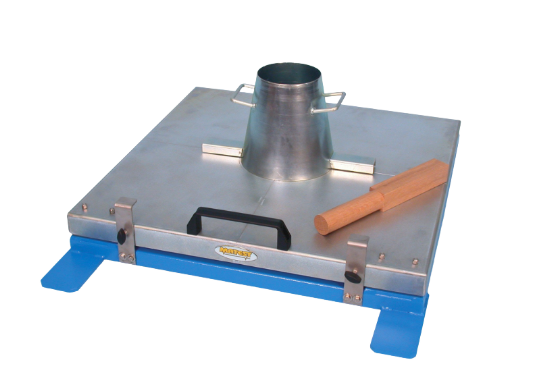
FLOW TABLE
Model No : AEC – 406-A
Standards As per : IS 1199: 1959
Flow Table Concrete
A Flow Table for Concrete is a laboratory apparatus used to determine the consistency and workability of freshly mixed concrete, especially for concrete mixes that are too dry for a slump test. The test helps measure the flow spread of concrete, offering a quantitative method to assess its fluidity and compaction characteristics.
- To evaluate the flowability of concrete mixes (mainly used for very stiff or dry concrete).
- Commonly used for testing cement mortars and high-performance concrete.
- Helps determine suitability of concrete mix for different construction applications.
- Useful in quality control labs, on-site testing, and educational demonstrations.
- Provides critical data for R&D in admixtures, water content, and concrete additives.
A fresh concrete sample is placed in a conical mould set on the center of the flow table.
- The mould is carefully lifted, allowing the concrete to spread.
- The flow table is then lifted and dropped 15 times in 15 seconds using a hand-operated mechanism.
- The spread of the concrete is measured in two perpendicular directions.
- The average diameter of the spread is recorded as the flow value of the mix.
- Robust Table Surface : Designed with a smooth, durable surface for accurate flow measurements.
- Consistent Manual Drops : Ensures uniform drops via cam or handleoperated mechanism.
- Heavy Duty Construction : Withstands heavy concrete mixes and repetitive testing cycles.
- Easy to Clean : The flat and smooth surface allows quick cleaning posttest.
- Ergonomic Design : Comfortable height and easy-to-operate mechanism for field and lab use.
- Integrated Measurement Grid (in some models) : Helps quickly measure the flow spread.
- Standard Compliant : Designed to match global testing standards.